
'No matter how severe sanctions the UN security council imposes on North Korea, the impact of the sanctions would depend on how faithfully they are enforced by China,' says Dr Rajaram Panda.
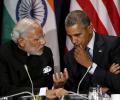
'Big countries do not agree on every set of issues.' 'Look, one of the differences in the relationship is that when we do not agree, we are sitting down and talking to each other.'
Coming down heavily on Pakistan, President Pranab Mukherjee has said unless it dismantles the terror infrastructure on its soil, there is no scope for progress in talks between the two countries.

RM took stock of progress in production of the fighter jets whose delivery to India will begin in September next year.

To bolster its arsenal amid recurring incidents of incursions by Chinese troops, India has sought the latest versions of unmanned aerial vehicles -- both the armed and surveillance -- from the United States.

China's South China Sea build-up and 'territorial sea' construct potentially affects 55 percent of Indian trade passing through the region. Hence, coordinating with the US and Japan could provide dividends to India in the longer run,' says Srikanth Kondapalli.

'His secretary of defence nominee, General James Mattis, says he expects Pakistan to take action against terrorists operating from its soil.' 'Any pressure the US can bring on the Pakistani regime terror-wise would pay dividends for India.'

In a 35-minute address to the Indian diaspora, the prime minister said that his government was not afraid of taking "big" and "tough" decisions in the interest of the country.
.jpg)
India and Japan on Monday agreed to enhance their defence and strategic cooperation to a new level during talks between Prime Minister Narendra Modi and his counterpart Shinzo Abe, who also decided to speed up negotiations on civil nuclear deal that could not be concluded now.
.jpg)
Pakistan on Friday said a meeting between Prime Minister Nawaz Sharif and his Indian counterpart on the margins of the United Nations General Assembly would be an "useful opportunity" to build trust and consolidate ties.

On the second leg of his trip to Central Asia, Narendra Modi makes quite an impression in Astana, as he talks about terror and trade, films and the future
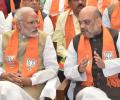
Modi could tap into the urban discontent and present a larger picture to first time voters and mid-career professionals.

India has undertaken a number of structural reforms.
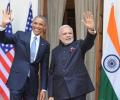
US President Barack Obama's India visit, marked by "high-end symbolism", is a signal to businessmen of both countries to look for opportunities from each other, Mahindra Group Chairman and Managing Director Anand Mahindra has said.

Leaders of the two countries, however, did discuss on Pakistan's nuclear safety and security which is an ongoing discussion.
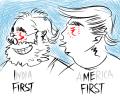
'Even in this age of self-willed and authoritarian leaders and spontaneous gestures, a script is still written,' notes Ambassador B S Prakash, imagining the 'talking points' are for the India-US summit on June 26.
We should be prepared for a phase of increased tensions in India-Pakistan relationship thanks to the evolving situation in Afghanistan, says Shyam Saran.

'Devyani -- she is a public servant and her personal life has already received far too much attention -- and her ambitious father now need to retreat to the background so that wiser diplomatic heads restore sanity to India-US relations as India prepares for parliamentary elections,' says Ambassador K C Singh.

'Pakistan's military leaders have to accept that the policy of proxy wars has damaged Pakistan more than it has damaged the enemy,' says former R&AW chief Vikram Sood.

The prime minister also said that country nurtures a mindset that loudly proclaims that terrorism is justified for political gains.
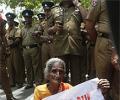
Prime Minister Manmohan Singh's decision not to attend the Commonwealth Heads of Government Meeting at Colombo has once again put the focus on alleged cases of human rights abuses in Sri Lanka.

'Modi wants to be pragmatic -- acknowledge the problem of Pakistan and that full reconciliation is essentially a non-starter, but at the same time grab the low-hanging fruits (such as trade) to put things on a more even keel, to engender enough stability in the relationship to allow him to focus on other priorities.'

'Chinese leaders rarely receive their foreign guests in cities other than Beijing. Such respect for India!' 'Does it mean that Modi could replicate "the warmth and unconventional way" by sending Indian troops into Tibet, as Xi did in Chumur (Ladakh) when he arrived in India? Of course, Indians are far too polite to do so,' says Claude Arpi.

"The RSS is trying to change the nature of India. Other parties haven't tried to capture India's institutions," he said.

'The real test will be in defence-related deals, for instance the Javelin anti-tank missile: Is the US willing to co-develop something with India, on terms that will support the 'Make in India' initiative? Is there defence technology transfer? Or will it dump old junk on India?' asks Rajeev Srinivasan.

The government must justify why we need to buy foreign reactors when we have developed up to 700 MWe unit-size pressurised heavy water reactors, a design which can be easily extended to 900 to 1000 MWe unit size. Why can't the 'Make in India' philosophy apply to indigenous nuclear reactors, more than 18 of which have been designed, built, and being operated by Indian engineers, asks Dr A Gopalakrishnan.

'How can Kashmir be demilitarised if the terrorist threat remains and Pakistan continues to incite elements in Kashmir to keep the internal situation unstable?' asks former foreign secretary Kanwal Sibal.

Minister for External Affairs Salman Khurshid speaks about the importance of the fourth edition of the India-US Strategic Dialogue, which he co-chaired with United States Secretary of State John Kerry in New Delhi

Prime Minister Narendra Modi, who recently completed one year in office, has, in an exclusive interview with Smita Prakash, editor, ANI, said the opposition alleging that his government is a "suit boot ki sarkar" is definitely better and more acceptable than being labelled a "suitcase" (ki sarkar), and satirically added, that after ruling for sixty years, the Congress has suddenly remembered the poor.
